Milewright's call: buy the COROS PACE 4 if you run outdoors most of the year and want flagship-grade GPS, topo maps and long race battery in the under $250 band.
Who it suits
Runners who train mostly outdoors and want dual-band GPS, maps and long race battery without a subscription
The catch
Wrist heart rate can wobble on cold runs and fast pickups
Runners tempted to step up to the bigger, brighter COROS screen
Workout drain rates project GPS battery well short of COROS's always-on claim; nobody has run one flat yet, and the promised fix hasn't shipped
Under $450
The most out-of-date thing about the COROS PACE 4 is COROS's own FAQ. It still says the watch can't do full mapping, two months after a COROS update gave it topo maps. The watch has outgrown its launch reviews. At a start line, its GPS kept pace with Garmin's flagship Forerunner 970 through the London Marathon. On race-day GPS, the only drain test projects a little past COROS's 24 h always-on figure. Nobody has drained a PACE 4 to zero on dual-frequency yet. Day to day, with the display left lit, it lasts about as long as COROS says. Where it lets you down is heart rate read at the wrist, on cold mornings and sharp pickups. A chest strap is the honest fix. Milewright's call: buy it if you run outdoors most of the year.
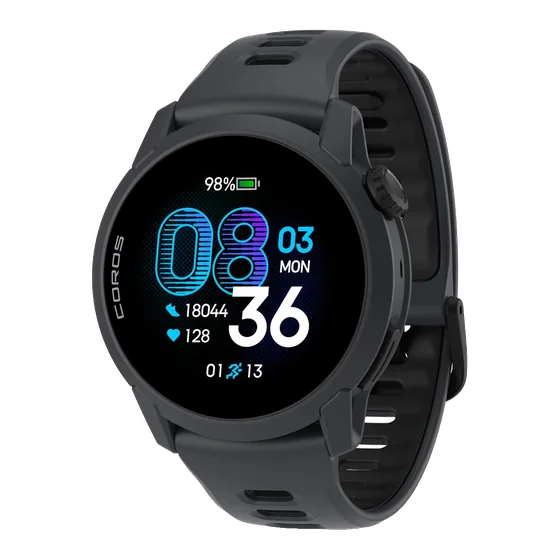
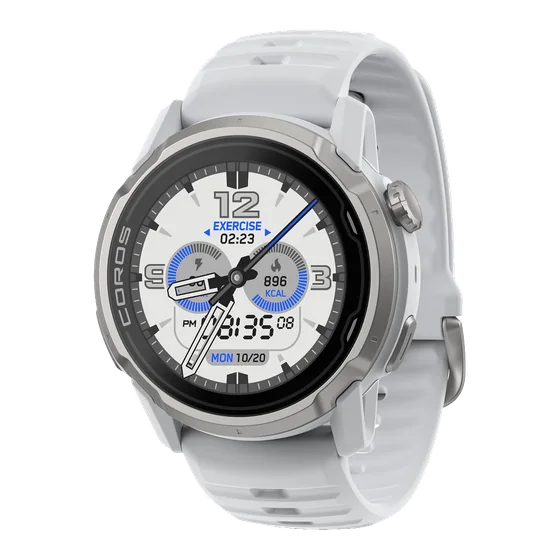
This is the standard PACE 4, model W336, the code on its FCC filing and US Amazon listings. With the nylon strap fitted it weighs 1.1 oz (32 g), barely more than a house key. It has a 1.2 in AMOLED screen rated at 1,500 nits, three buttons plus a touchscreen, and dual-band GPS. It records pool, open-water and triathlon sessions, and stores MP3s for Bluetooth headphones. There's a microphone for voice notes but no speaker, no payments and no Spotify. There's no subscription either: COROS's training plans, race predictor and virtual pacer are free.
Owners mostly forget it's there, which is the point. Their complaints are small and physical. The silicone band's keeper tab works loose, badly enough that one owner duct-taped it. Some find the plastic build cheap beside its pricier sibling. Annoying, and none of it touches a run. For a runner who trains outdoors, this is the watch we'd buy.
With the screen always on, yes. On raise-to-wake, runners who train get less than the box says. On GPS, nobody has run one flat yet. COROS prints battery mode by mode, with and without the always-on screen. I'd want that from any supplier's data sheet: one flattering number can't be checked, and this can. Always-on tests land near COROS's 6 day figure. With a few workouts a week on raise-to-wake, testers got 10–14 days against the 19 days on the box, a figure COROS quotes with sleep tracking but says nothing about training. The single GPS drain test projects a little past COROS's 24 h always-on figure. The 41 h All Systems claim hasn't been tested at all.
COROS's claim
Setting
What testers and owners got on this model
41 h
All Systems GPS (30 h with always-on)
No independent test found
31 h
Dual-frequency GPS (24 h with always-on)
No rundown; drain during workouts projects a little past COROS's own 24 h always-on figure (DC Rainmaker, Nov 2025)
19 days
Daily wear, raise-to-wake (6 days with always-on)
10–14 days with a few workouts a week (TechRadar, Feb 2026); a little over a tenth of the battery a day (Tom's Guide, Nov 2025); one owner gets 12 days, settings unstated
6 days
Daily wear with always-on
About 6 days with an hour of GPS a day (DC Rainmaker); 4–5 days running daily in multi-band (Tom's Guide); about 5 days across six months and about 1,500 miles (The Run Testers, May 2026)
Even on that projection alone, a marathon on the most accurate GPS setting leaves hours in hand. The always-on screen decides how often you charge. Leave it on and it's every five days or so. Switch to raise-to-wake and expect somewhere between ten days and a couple of weeks, depending on how much you train. Planning something longer than a marathon? Our GPS battery planner tells you whether it will last the day. If your long day is really two days on GPS with no charger in sight, the planner sends you to the Suunto Vertical 2, not this watch.
What has changed since launch
Firmware has made the PACE 4 a more capable watch than the one reviewed in November 2025.
When
Firmware
What changed
Nov 12, 2025
Launch
Breadcrumb navigation only, no maps
Dec 2025
V3.1308.0
Control music and podcasts playing on your phone
Mar 2026
COROS's March update
Hybrid Fitness mode for mixed strength and cardio, plus Pace Strategy and Hill Alerts
May 2026
Brand-wide update
Bricking reports across COROS watches, mostly older models
Sep 26, 2026
V3.2008.0
Global landscape and topo maps, after a public beta from Sep 4
Does the PACE 4 have offline maps now?
Yes, since the September 26 firmware. They're proper topo maps, but not routable. The watch shows the trail and your route line, but won't plot a new way home after a wrong turn. Storage is the limit: 4 GB, and more than half was already used on DC Rainmaker's watch before any maps went on. Think one region, not the whole country. The 1.2 in screen is also small for reading a junction. Nobody in our evidence has reviewed the finished maps release yet.
If a review says the PACE 4 has no maps, check its date. Several widely read reviews still say so, and so does COROS's FAQ. Every one of those statements was written before the update. For which COROS to choose with maps in mind, see COROS PACE 4 vs PACE 3.
Was the PACE 4 caught in the May 2026 update failures?
The watches that died after May's firmware were mostly two to four years old. The PACE 4 wasn't in the firing line, and no owner report in our research describes a bricked one. How COROS handled it should give you pause. Owners first got AI chatbots offering a discount on a new watch; replacements came only from June 17. DC Rainmaker notes it isn't the first large-scale failure COROS has fumbled. Your protection is the 2 year warranty, and a maker that gets there in the end, slowly. No recall touches the PACE 4. None of this is a reason to pass on it. We'd still buy it.
GPS: the reason to buy it
Every tester who measured it put the PACE 4's GPS at or near the top of the field, from open roads to downtown towers. The Quantified Scientist ran the same loop again and again to see whether it draws the same line each time, and it held its line tightly lap after lap. The Run Testers raced it at the Paris Half and London Marathon beside a Forerunner 970 and found it near flawless. This budget watch won't steal a PR between tall buildings. That makes it the pick for the money in our most accurate GPS watch guide. Marathoners who want race-grade GPS plus a flashlight and Garmin's deepest training tools will find the Forerunner 970 picked there instead.
Can you trust its wrist heart rate on a cold run?
Not always, and this is the honest catch. On steady runs, most testers who checked it against a chest strap found it close, apart from the odd spike at the start or after a pause. The Quantified Scientist tested through the winter against a Polar H10 and found it poor on runs. He suspects cadence lock: the sensor mistakes your footstrike rhythm for your pulse. Owners lean his way on cold mornings and sharp pickups, and several now run with a strap. Like every watch, it lags in the weight room. Two tattooed owners, though, report it works where their Garmins didn't.
Train by heart-rate zones in January? Pair a strap. COROS's FAQ says the PACE 4 takes Bluetooth heart rate straps. It doesn't mention ANT+, so check yours does Bluetooth.
The other catches owners hit
Will VO2 max fill in if you only run on a treadmill?
We can't promise it will. One Northeast US owner's report: months of treadmill-only running with a Polar H10 and COROS's POD 2 left his VO2 max, Running Fitness and Running Efficiency blank. Training Load filled in. He says he wouldn't have bought the watch had he known. It's a single report, and COROS hasn't answered it. Run outdoors and it won't touch you. Spend the whole winter on a belt and it might.
A few smaller quirks. The dial sits where some wrists press it; the user guide says the watch ships with Hold to Unlock auto-lock on. Weekly training load resets every Monday, so last week's long run vanishes from your wrist overnight. And there's no score telling you whether you're fit to run today, just an overnight HRV reading and your own judgment.
Garmin Forerunner 70: better for a treadmill-only winter
If most of your miles this winter will be indoors, we'd buy the Garmin Forerunner 70 instead. Garmin's manual shows how to calibrate its treadmill distance against the belt after a run. TechRadar found its treadmill tracking reliable. Whether its fitness estimates fill in from treadmill-only running isn't in our evidence. You give up maps and the triathlon mode. Outdoors, its single-band GPS kept pace with Garmin's multi-band flagship in testing.
The Pro adds a bigger, brighter screen, titanium, sapphire and 32 GB for maps. The battery is the problem. Nobody has run one flat on GPS yet, but DC Rainmaker's drain rates in workouts projected under 20 h in the mode COROS rates at 30 h with always-on. One owner's half-marathon drain points the same way. COROS blames bugs and promised a fix this month. On October 30 the Pro's release notes still showed nothing newer than the September build. Wait for it.
The call: buy the PACE 4
Our pick
Our call: buy it
For a runner who trains outdoors, the PACE 4's GPS delivers. Worn with the display always lit, it lasts close to COROS's figure, and the one GPS drain test projects about where COROS says. It has also gained maps since most of its reviews were written. Bring a chest strap for cold intervals and there's little left to complain about. COROS vs Garmin sets it against Garmin's options in the same band. This is the watch we'd buy: one that got better after the reviewers went home.
Research count for this page: 5 models weighed; 3 maker manuals among them; across this site's research, 367 sources kept in full; 148 Reddit threads read, kept as the reader's summary, not in full.
Identity. The PACE 4 sold in the US is W336 (FCC ID 2BBGF-W336, granted January 22, 2026; also on the US Amazon listings for the standard and aluminum editions). COROS holds a second FCC ID named "COROS PACE 4", 2BBGF-W335 (granted November 24, 2025), with a different reported wrist SAR. The filings don't say how it differs, and every US listing in our research carries W336 rather than W335. The aluminum and Black Crystal editions share W336 but have a different bezel; this page's evidence is on the standard polymer-bezel watch unless stated.
Battery, tester by tester.
Source
Date
Setting
Result
COROS battery specifications
Read Nov 2026
Mode by mode
41 h All Systems (30 h always-on); 31 h dual-frequency (24 h always-on); 19 days daily with sleep tracking (6 days always-on)
DC Rainmaker
Nov 2025, launch firmware
Max GPS, always-on
Drain rate during workouts projecting slightly past the 24 h always-on claim (a projection, not a rundown); about 6 days always-on with about an hour of GPS a day
Tom's Guide
Nov 2025
Always-on, multi-band, daily runs
4–5 days; a little over a tenth of the battery a day on raise-to-wake
TechRadar
Feb 2026
Raise-to-wake, a few workouts a week
10–14 days
The Run Testers
Six months to May 2026, about 1,500 miles
Always-on, sleep tracking
About 5 days
One owner (r/Coros)
Several months
Not stated
12 days, against 5–6 days on his Forerunner 570
No tester ran either GPS mode to empty. The dual-frequency claim rests on one projected drain rate, and the 41 h All Systems claim is untested. A best-of guide from OutdoorGearLab gives the PACE 4 about six days always-on and roughly 19 days on gesture wake; those match COROS's claims exactly and aren't backed by a measurement in our model research, so we don't count them as a test.
PACE 4 Pro battery. DC Rainmaker's workout drain rates projected under 20 h in Max GPS with always-on, against COROS's 30 h always-on figure; COROS blamed GPS-subsystem and cycling sensor-scanning bugs and promised a November fix. Max Kelly's half marathon, on a COROS-supplied watch with the GPS mode not stated, also projects short of the claim. No full GPS rundown has been published.
GPS. DC Rainmaker: very good in side-by-side tracks, downtown included. Tom's Guide: excellent against a Forerunner 970 and a COROS Vertical 2. The Run Testers: near flawless over six months against a Forerunner 970. The Quantified Scientist: on a repeated-loop test, the tracks stayed tightly on the same line from lap to lap. TechRadar compared total distance against a single Huawei reference watch and found them close, a weak method we gave little weight.
Heart rate, the split. Good on runs: DC Rainmaker; Tom's Guide (spikes at the start and after pauses); The Run Testers (matched a Forerunner 970 in races). Poor on runs: The Quantified Scientist, winter testing against a Polar H10, suspected cadence lock. His indoor cycling result was a 0.97 correlation with the strap, and outdoor cycling was good; DC Rainmaker saw struggles on outdoor rides with quick stops. Strength: lags a chest strap (The Quantified Scientist; Tom's Guide). Owners who distrust it use COROS's armband or a Polar strap. The likeliest explanation for the running split is cold weather combined with how the watch sits on a particular wrist. Open.
Maps. DC Rainmaker tested the September public beta and found map rotation slow. No review of the finished V3.2008.0 maps has appeared since.
Swimming. Open water: acceptable, with one corner cut substantially (DC Rainmaker). Pool: one owner logged sixteen long sessions in a long-course pool with no miscounted distance; another owner, model not confirmed, sees laps trigger early. Pool heart rate read low for one owner. No tester has published pool lap counts.
Sleep. Sleep and wake times within minutes of other devices (DC Rainmaker); poor agreement on sleep stages (The Quantified Scientist).
Owner notes moved from the review. A first-time owner learned the watch by asking it things with voice control. The Run Testers found the buttons slightly less responsive after six months and turned on button lock because the wrist bone pressed the dial. Onboard MP3 playback works, but swapping music and podcast files over USB is tedious. Owners who moved up to the PACE 4 Pro praise its build feel over the PACE 4's.
Conflicts that are explained. The stale "no offline maps" statements: Tom's Guide (Nov 2025), TechRadar (Feb 2026), The Run Testers (May 2026) and the coros.com FAQ, against "global landscape and topographic maps" in COROS's user guide and the V3.2008.0 release notes; explained by the September 2026 firmware. Phone music controls absent (Tom's Guide, Nov 2025) against present (DC Rainmaker, COROS FAQ): explained by V3.1308.0 in December 2025. A 41 h "multiband" headline against 31 h: 41 h is All Systems, 31 h is dual-frequency.
Trust. The 2025 Bluetooth security flaws in older COROS watches were fixed before the PACE 4 launched, per COROS's statement. On the May 2026 update failures, COROS says they were a sliver of millions of updates; DC Rainmaker puts the count in the low thousands of watches and estimates a share of the Reddit pile-on came from fake accounts. Replacements began June 17, 2026.
Gaps. A full GPS rundown in any mode. ANT+ support (not stated by COROS). The finished maps release (no review since the September beta). Button and battery wear beyond six months (one tester). The treadmill-only metrics gap (one owner, unresolved).
Considered and left out. The Suunto Run tracks well but trails the PACE 4 on maps, and owners report structured plans not reaching the watch. The Forerunner 165 is an older Garmin without Training Readiness or Training Status.
Milewright doesn't test watches. It sets each maker's claim against what labs, reviewers and owners measured on the exact same model, and tells you which number to believe.