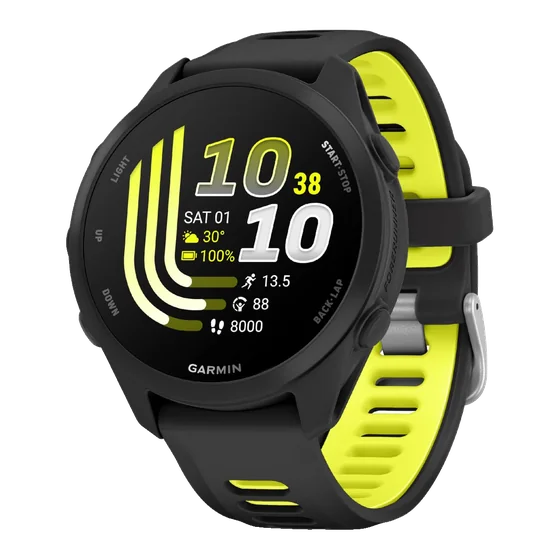
The quick answer
Our pick
Garmin Forerunner 970
Worth the step up
Opens Amazon.com · Prices change often
Running
By price band
Trail & outdoors
Multisport & gym
Compare & decode
The quick answer
Worth the step up
Opens Amazon.com · Prices change often
Price bands, not prices
| Watch | Verdict | Who it suits | The catch | Price band and link |
|---|---|---|---|---|
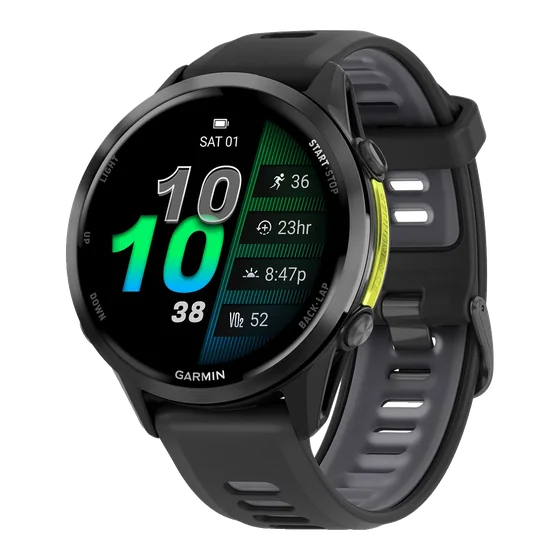 Garmin Forerunner 970Our pick | Worth the step up | Runners who train on trails or in unfamiliar cities, head out before sunrise, or want fewer charges | Some units develop touchscreen ghost touches; Garmin swaps them case by case | Under $800View on Amazon (opens in a new tab) |
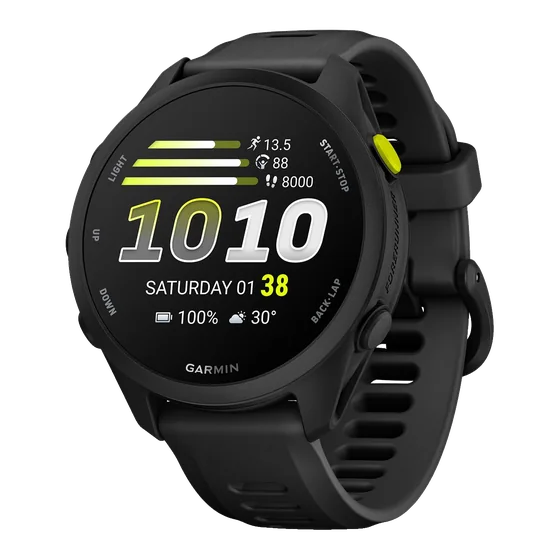
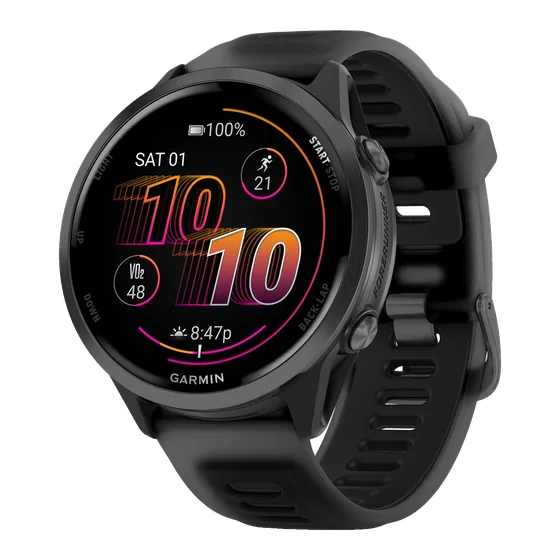 Garmin Forerunner 570 – 47mmBuy | Road runners who never need a map | Road marathoners and triathletes on familiar routes who want music on multi-band GPS, never need a map, and don't mind charging twice a week with the screen always on | No maps and no LED flashlight, and it needs charging about twice a week with the screen always on | Under $600View on Amazon (opens in a new tab) |
Put a Forerunner 570 (47mm) beside a Forerunner 970. You are looking at the same 47mm case, the same 1.4 in AMOLED screen, the same heart-rate sensor and the same software. Garmin's extra price band buys three things you can point at: maps, a flashlight that deserves the name, and about half again the GPS battery in every mode. Milewright's pick for a runner weighing that step is the Forerunner 970. The maps and the light earn their keep the first time you run somewhere new or before sunrise. And Garmin rates it for 21 hours of multi-band GPS against the 570's 14, so a long run never has to be rationed.
Garmin Forerunner 970Under $800Opens Amazon.com · Prices change often
The 570 wins one buyer outright: the road runner or triathlete on familiar routes who will never open a map. It runs the same race software for one band less. For that runner, the 970's extras are a toolbox left in the garage.
Price band: under $800
Garmin promises 21 hours of its most accurate multi-band GPS. It claims 23 on Auto Select and 26 on GPS alone. The closest evidence is a 10K that Tom's Guide raced on multi-band, display lit the whole way. The 970 drained at a pace that projects to about 21 hours. That's a projection from one short race, not a rundown. Nobody has yet run one flat on multi-band to check Garmin's figure. Testers checking it against several reference units found its road and trail tracks perfect or close to it. It also landed within a stone's throw of a certified 10K.
It was a different watch then, in the only way that matters: its software. On launch firmware, DC Rainmaker got 2.5 days with the screen always on. That was at the default brightness, with an hour or three of GPS a day. Dropping to one-third brightness roughly doubled it. A screen lit all day is the biggest power draw on the watch, and Garmin's default was bright. Garmin then shipped battery updates. Tom's Guide got about 4.5 days at six months, below the brightest setting. DesFit got about 5.5 days after a year at the lowest brightness. Owners a year or so in report going about 14 days on a charge. Few of them mention their display setting, though it looks as if most leave always-on switched off. If a review quotes two and a half days, check its date.
Where the 970 lets owners down is its touchscreen, and only on some units. A ghost-touch thread on Garmin's own forum, where scrolls register as taps, has run to 160 replies. Some owners say a replacement watch cured it. That points at hardware on certain units, and Garmin is handling it case by case. Nobody has published how many watches are affected, and a busy forum thread measures noise, not numbers. It's a real nuisance on the units it hits, and not enough to change our call.
It suits anyone who runs where they might get lost, runs in the dark, or hates charging. We'd buy the 970.
Garmin Forerunner 970Under $800Opens Amazon.com · Prices change often
Price band: under $600
Garmin's manual promises the 47mm anywhere from 8 to 18 hours of GPS, depending on mode and music. A career signing off jet engine parts taught me that "8 to 18" isn't a specification. It's the opening line of a negotiation. In Garmin's favor, the manual prints every mode in one table. That's exactly how a battery should be specified, and more than most makers manage.
Yes, with hours to spare. Multi-band is the mode a marathoner should race in, and Garmin claims 14 hours for the 47mm. Tom's Guide raced a 570 over a 10K on multi-band, its display never going dark. Its case size wasn't stated. It drained at a pace that projects a couple of hours past the manual's figure. Nobody has measured the 47mm itself over a long effort. So that projection is the best evidence there is, not proof. Over about 150 miles on the 47mm, Tom's Guide found no significant GPS or heart-rate errors.
What the 570 asks of you, if you like the screen lit all day, is a charger every few days. The 47mm lasted about 3.5 days between charges in Tom's Guide's test with daily runs. With the screen waking on a raise of the wrist, Android Central got about 7.5 days. Garmin's own manual lists the fixes: stop using the always-on screen, lower the brightness, and shorten the screen timeout. Tom's Guide notes a later update improved battery, so the always-on figure may now be a little better. Charging twice a week is a chore, not a crisis.
For a road marathoner or triathlete on familiar routes who never needs a map, we'd buy the 570 and keep the difference. That holds if you race with music on multi-band, too. That's the runner our Forerunner 570 review is written for. Our triathlon watch guide shows where it fits in a race season.
Garmin Forerunner 570 – 47mmUnder $600Opens Amazon.com · Prices change often
Garmin's claims come from each watch's US manual. Measured figures are on the exact watch unless the cell says otherwise.
| Mode | Forerunner 570 (47mm) | Forerunner 970 |
|---|---|---|
| GPS only | 18 hours claimed; not measured | 26 hours claimed; not measured |
| Auto Select (SatIQ) | 16 hours claimed; not measured | 23 hours claimed; a four-hour hike at lowest brightness, navigating, projects to about 30 hours |
| All + Multi-Band | 14 hours claimed; no 47mm test (a 570 of unstated size, in one 10K, drained at a pace projecting a couple of hours past that claim) | 21 hours claimed; one 10K drained at a pace projecting to about 21 hours; no rundown |
| Multi-band with music | 8 hours claimed; not measured | 12 hours claimed; not measured |
| GPS only with music | 9 hours claimed; not measured | 14 hours claimed; not measured |
| Daily wear, maker's figure | 11 days claimed | 15 days claimed |
| Daily wear, screen wakes on raise | about 7.5 days measured | not measured |
| Daily wear, screen always on | about 3.5 days measured | 2.5 days on launch firmware; about 4.5 days after updates |
| Daily wear, display setting unstated | no figure | about 14 days in owners' reports, likely not always-on; about 8.5 days in iRunFar's trail use |
Music costs both watches roughly a third to half of their GPS hours. The 570's 8 hours of multi-band with music still covers a road marathon on Garmin's figures. It's the runner whose headphone runs go past a marathon who gains the most from the step up. Planning an ultra or a full day on the trail? Our battery planner runs those numbers against your own race.
| Forerunner 570 (47mm) | Forerunner 970 | |
|---|---|---|
| Maps | Breadcrumb courses only | Preloaded road and trail maps, with routing |
| Flashlight | Screen lights white | White and red LED, with strobe |
| Running Tolerance | No | Yes |
| Lens and bezel | Gorilla Glass 3, aluminum | Sapphire, titanium |
| Storage | 8 GB | 32 GB |
| ECG app | No | Yes |
| Weight | 1.8 oz (50 g) | 2.0 oz (56 g) |
| Same on both | 47mm case, 1.4 in AMOLED, multi-band GPS, Gen5 heart-rate sensor, music, Garmin Pay, triathlon mode | |
| Our call | Buy, for road runners who never need a map View on Amazon (opens in a new tab) | Buy, our pick View on Amazon (opens in a new tab) |
Both run on Garmin's newer platform and get its new features together. The cheaper watch won't be left behind on software. Neither plays Apple Music, and no recall touches either watch.
Worth the step up
Most runners weighing these two already wonder where the trail goes, or already run in the dark. The 970 gives them a map for the first and a real light for the second. It also has enough battery that the watch is the last thing on their mind at mile 20. It's our pick for marathon training too, for the same reasons. The 570 is a fine watch with nothing missing for the road. The 970 is the one that still makes sense the day you leave it.
Garmin Forerunner 970Under $800Opens Amazon.com · Prices change often
The 970 comes in one case size. Its record:
The 570's record is for the 47mm unless a line says otherwise:
Why the sources disagree: firmware date and brightness account for the 970's 2.5-day launch figure against later measurements, and display mode most likely accounts for owners' longer figures against reviewers' on both watches, though most owners don't state it.
DC Rainmaker's sea swims in June 2025 found the 970's tracks weaker than recent Garmins, struggling to re-acquire after treading water, and in a September 2025 comment said it was still not fixed. the5krunner's single calm lake lap came within a couple of percent of the official distance, with a smoothed track; an Apple Watch Ultra 3 on the other wrist followed the reference more closely. DC Rainmaker swam a 570 of unstated size on the same day as a 970 and found it a touch better, which he put down to luck. Owners report 970 pool lap-count errors on firmware 15.52 and 17.33, with open turns counted worse than flip turns. No tester has published a pool lap-count test of either watch.
Each manual lists Garmin Connect+ items as paid: AI insights including nutrition, LiveTrack+, Garmin Trails and indoor-activity tracking. The 970's manual adds Outdoor Maps+ as a paid map option; TopoActive maps are included.
Every major streaming app we checked lists both watches for offline downloads, provided you pay for that service's premium plan. A Connect IQ Store search for Apple Music returns watch faces only.
The CPSC recall database returned no recall naming Garmin on 4 November 2026.
Research behind this page: 2 models weighed; 2 maker manuals among them; across this site's research, 367 sources kept in full; 148 Reddit threads read, kept as the reader's summary, not in full.
How we research
Milewright doesn't test watches. It sets each maker's claim against what labs, reviewers and owners measured on the exact same model, and tells you which number to believe.
By price band
Trail & outdoors
Multisport & gym
Compare & decode
Reviews